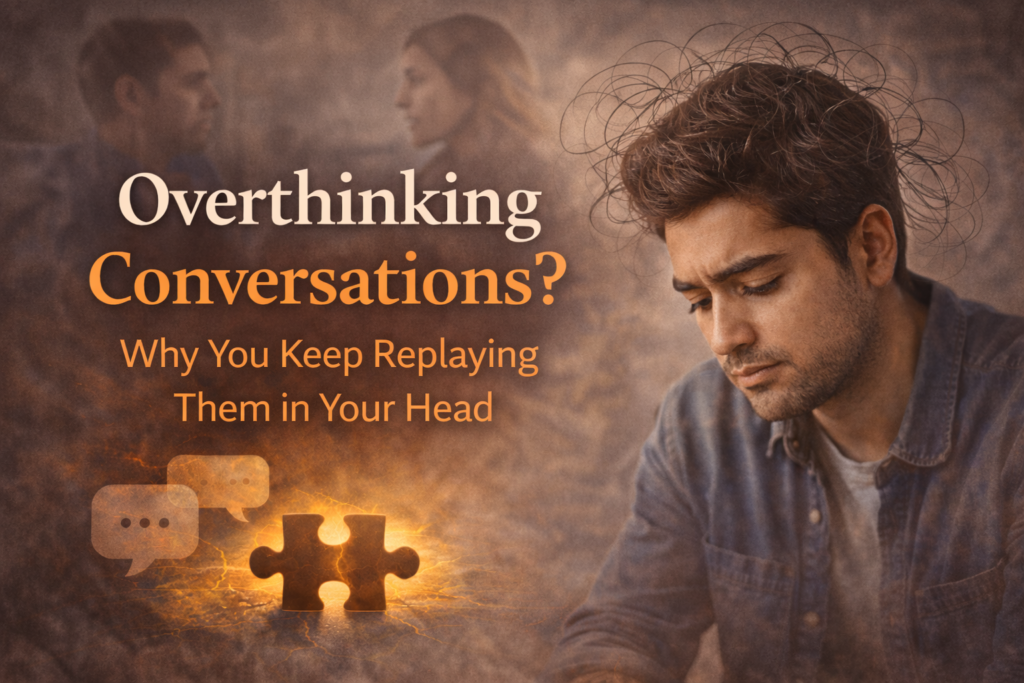
Why You Keep Replaying Conversations in Your Head
There’s a moment after certain conversations where it doesn’t really end.
You walk away, move on with your day, shift your attention to something else—but part of your mind stays there.
Replaying it.
What you said. What they said. The tone. The pause. The way something might have landed differently than you intended.
It’s not always intense. Sometimes it’s quiet. Subtle. Just enough to keep pulling your attention back.
And even when you know it doesn’t need this much energy, it’s hard to let go.
When Your Mind Doesn’t Fully Close the Loop
Most conversations end externally.
But internally, not all of them feel finished.
When something feels unclear—when there’s uncertainty, tension, or even just a slight sense that something was off—your mind tries to resolve it.
Not because something is wrong.
Because it’s trying to make sense of it.
So it goes back.
Replays.
Adjusts.
Searches for a version that feels more complete.
It’s Not Just About the Conversation Itself
What you’re replaying isn’t always about what actually happened.
It’s about what it might mean.
How it was perceived. Whether it affected the relationship. Whether you said too much, or not enough. Whether something subtle changed that you can’t quite name.
That uncertainty is what keeps the loop going.
Not the words themselves—but what sits underneath them.
Why Certain Moments Stick More Than Others
Not every conversation lingers.
Some pass easily. Others don’t.
The ones that stay tend to touch something more personal—how you’re seen, how you’re understood, how you show up in relationships.
Even small moments can carry that weight.
A delayed response. A shift in tone. A comment that felt slightly off.
On the surface, it’s minor.
But internally, it connects to something that feels more important.
When Overthinking Becomes a Pattern
Replaying something once or twice isn’t unusual.
But when it becomes consistent—when your mind returns to interactions long after they’ve ended—it starts to create a kind of mental fatigue.
You feel pulled backward instead of forward.
Present, but not fully present.
It’s not just thinking.
It’s holding.
Why Trying to “Stop Thinking About It” Doesn’t Work
Most people respond to this by trying to shut it down.
Distract themselves. Stay busy. Push the thoughts away.
And sometimes that works temporarily.
But the reason it comes back is because it hasn’t been processed—it’s been avoided.
Your mind isn’t trying to be difficult.
It’s trying to finish something it doesn’t feel is complete.
What Actually Helps Create Closure
Closure doesn’t always come from solving the conversation.
It often comes from understanding why it stayed with you in the first place.
What about that moment felt important?
What did it connect to?
What part of it are you still trying to resolve?
When you shift from replaying the situation to understanding your response to it, the loop begins to loosen.
Not immediately.
But noticeably.
A Different Way to Look at It
Those conversations you can’t stop thinking about aren’t random.
They’re pointing to something.
Not necessarily something wrong—but something meaningful to you.
Something your mind doesn’t want to move past without understanding.
Support That Helps You Process, Not Just Cope
At Elemental Care Services, we work with individuals who feel stuck in patterns like this—replaying, overthinking, and trying to make sense of interactions that don’t feel fully resolved.
You don’t need to silence your thoughts to move forward.
Sometimes you just need to understand them differently.