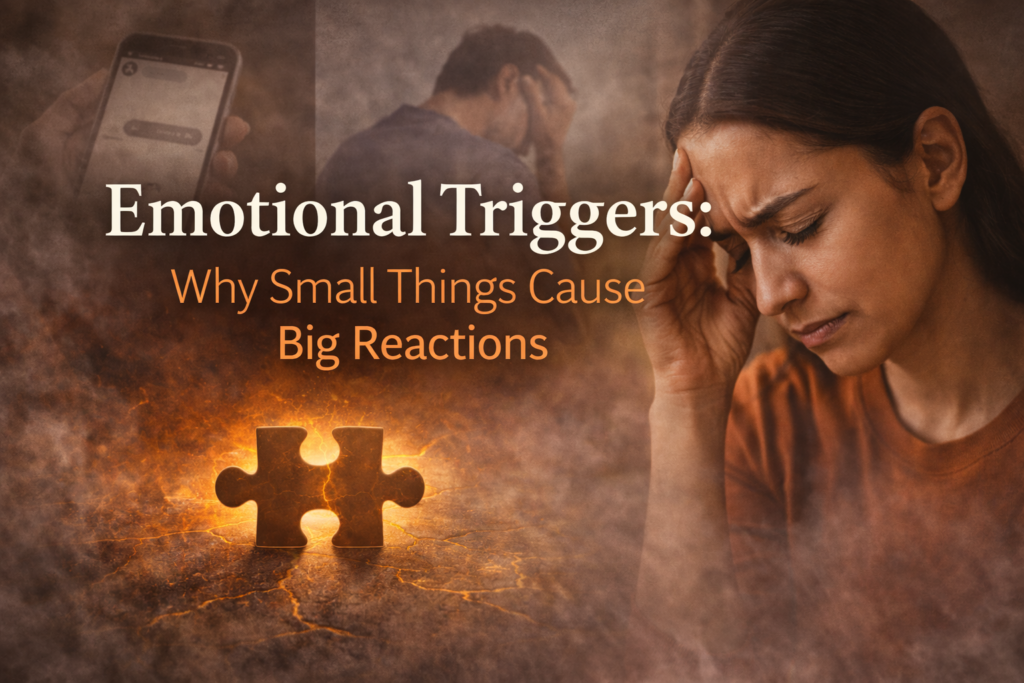
Why Small Things Trigger Big Reactions
(And What It Might Be Telling You)
Sometimes it’s not the situation.
It’s your reaction to it.
A short message that lands harder than it should. A small inconvenience that lingers longer than expected. A conversation that stays with you long after it’s over, replaying in the background when you’re trying to move on with your day.
If you look at the moment on its own, it doesn’t quite add up. It doesn’t seem like enough to justify the weight of the reaction.
But internally, it feels real.
And often, confusing.
Most people don’t pause here. They move past it quickly, brushing it off as stress or fatigue or just a bad day. And sometimes that’s all it is. Not every reaction carries deeper meaning.
But when it starts to feel familiar—when the same types of moments consistently bring up the same intensity—it usually isn’t random.
It’s patterned.
And patterns tend to point somewhere.
The word “trigger” gets used often, but it’s usually simplified into something immediate, as if it begins and ends with the situation in front of you. In reality, it rarely works that way. What you’re reacting to in the moment is often connected to something that existed long before it.
Experiences that were never fully processed. Patterns that formed over time. Situations that taught your mind and body how to respond before you were ever aware of it happening.
Most of the time, those things stay quiet. They don’t interfere. They don’t demand attention.
Until something familiar brushes against them.
And when it does, the reaction that follows isn’t just about what’s happening now. It’s layered with everything it connects to. That’s why it can feel disproportionate. Not because it’s wrong—but because it’s carrying more than the moment itself.
This is where it can start to show up in subtle ways. Irritation that feels sharper than expected in an otherwise normal conversation. Taking something personally even when you don’t want to. Pulling back or shutting down after a small interaction without fully understanding why. Replaying moments long after they’ve passed, as if your mind is trying to resolve something it can’t quite finish.
Individually, none of these feel extreme. They’re easy to dismiss. Easy to normalize.
But over time, they create a kind of quiet friction—something just slightly off in how you move through your day, how you respond to people, how you experience things that used to feel simpler.
Most people try to manage that friction by controlling their reactions. Being more patient. Letting things go faster. Saying less. Doing more to stay steady on the surface.
And that can work, for a while.
But control tends to stay at the surface level. It helps you navigate the moment, but it doesn’t explain it. It doesn’t reduce the weight behind it.
Awareness does something different.
It slows things down just enough to notice what’s happening underneath. Not to fix it immediately, and not to analyze it into something clinical—but to recognize it as a pattern instead of a one-off moment.
That shift matters.
Because once something is seen as a pattern, it stops feeling random. And when it stops feeling random, it becomes something you can begin to understand instead of something you just react to.
There’s often a quiet pressure to figure everything out quickly—to trace every reaction back to its exact origin, to make sense of it all at once. But understanding doesn’t usually work like that.
More often, it builds gradually.
It starts with noticing that the reaction exists, that it repeats, and that it feels familiar in a way that isn’t tied to just one moment. From there, clarity tends to unfold over time, not all at once.
Working through these patterns isn’t about eliminating them completely. It’s about reducing their intensity and changing your relationship to them. Creating just enough space between what happens and how you respond so that the reaction doesn’t feel automatic anymore.
Over time, what once felt immediate starts to feel manageable. What once felt confusing starts to feel more predictable. And that alone can change how you experience your day-to-day life.
Those moments that feel bigger than they should aren’t random.
They’re information.
Not something to judge or push away—but something worth understanding, at your own pace.
At Elemental Care Services, we often work with people who aren’t in crisis, but who recognize that something in their responses feels off, or heavier than it should. There doesn’t have to be a defining event or a clear explanation to begin paying attention to that.
Sometimes it starts exactly here—by noticing that certain reactions don’t quite match the moment, and choosing not to ignore that.