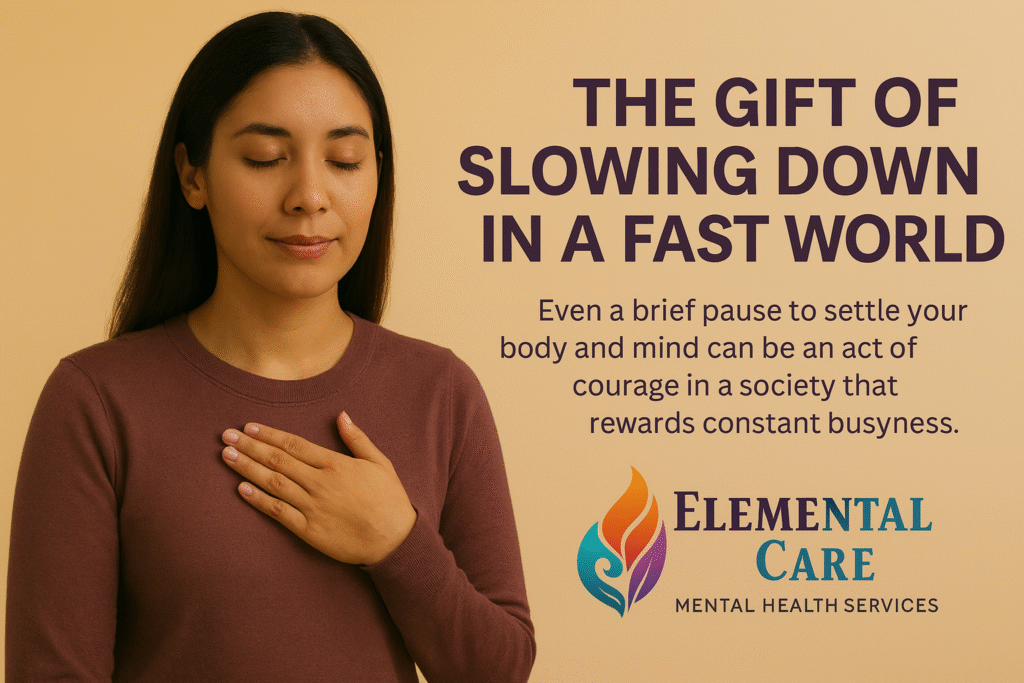
The Gift of Slowing Down in a Fast World
The world measures worth by output — productivity, hustle, efficiency.
So we speed up, pile more on, and tell ourselves we’ll rest “when things calm down.”
But life rarely slows down on its own.
And the truth is: constant busyness isn’t a badge of honor — it’s a slow drain on your energy, clarity, and emotional health.
Sometimes the most courageous decision you can make is to step off autopilot and slow your pace on purpose.
At Elemental Care Services, we believe rest isn’t passive or lazy.
It’s an active investment in your emotional resilience, your nervous system, and your ability to show up for the things and people you care about.
Why Slowing Down Feels So Damn Hard
For a lot of us, the moment we pause, guilt kicks in:
“I should be doing more.”
“I’m wasting time.”
“Other people are pushing harder.”
That mindset isn’t motivation — it’s survival mode.
We learn to speed up because slowing down once felt dangerous, disappointing, or unproductive.
But taking a break isn’t falling behind.
It’s choosing a pace that doesn’t break you.
How Therapy Helps You Press Pause
Therapy gives you structure and accountability around slowing down, so you’re not just “trying to relax” while drowning in stress.
It might look like:
Naming emotions you’ve been too focused to feel
Understanding what pushes you into “overdrive”
Challenging beliefs that treat rest as failure
Creating boundaries that protect your energy
Building habits that make downtime a normal part of life—not a reward for burnout
Rest is not an emergency exit.
It’s a skill you can learn.
A Gentle Practice for Today
If life feels heavy, try a small experiment:
Set a 5-minute timer and stop doing anything “productive.”
Let your body settle — unclench your jaw, drop your shoulders, breathe.
Ask yourself:
“What’s one thing I can release today that won’t matter in a week?”
Let that be enough.
Small pauses create space for big shifts — clarity, calm, and a sense of control you might not realize you’ve been missing.
You Don’t Have to Earn Rest
You don’t need to burn out to justify taking care of yourself.
You don’t need a breakdown to deserve support.
You’re allowed to slow down before life forces you to.
If you’re ready to build a life with less pressure and more peace, we’d be honored to help you get there.